
Akhil
Raveendran


Nissan
Product Information Management Platform
An enterprise system that internalised data governance and simplified complex data constraint authoring, leading to 1.2M Euros in annual savings and 50%+ reduction in data errors.
My Role
Product Designer ( PoC to Rollout )
Duration
Q2 FY23 - Q1 FY24
Q3 FY24 - Q1 FY25 (Me+1 UI designer)

Business Problem.
We solved a critical enterprise challenge where market-specific product data was siloed across decentralised, non-auditable sources (Excel) and managed by an external vendor. This presented a significant data integrity and fuelled high operational costs.

Impact
50% + reduction
In Error Correction requests, based on the tickets raised.
5 x times
More task completion from the existing process,
1.2 Million Euros
savings per year from implementing the product in Europe alone.

Approach to Solution
Designed and defined the workflow, information, and user archetypes. Propose future product positioning and strategy for how the product can enhance both upstream and downstream processes.

Conducted multiple discovery sessions with stakeholders across regions, broadly asking questions as mapped above on the as-is process to gather insights and takeaways to create the following high-level to-be process of user archetypes.


The high-level proposal was an outcome of over 8 weeks of intensive discovery sessions with the Europe and Middle East marketing teams. Entering data in the portal is the major activity to be performed, for which a deep understanding of the information to be authored was created as follows.
Based on the data, 7 types of data entry were identified as below, with each type requiring a specific type of data entry. Ranging from typing in data in fields to creating conditions and constraints.
Type 1: Version name.
Type 2: Technical specs like colour, capacity, etc.
Type 3: Packages.
Type 4: Constraints.
Type 5: Price.
Type 6: Accessories.
Type 7: EIM.

Solution
With wireframes prepared, we conducted multiple user tests and discussions with stakeholders and potential users of the platform in diverse regions to test multilingual input, roll out refinements, and updates in subsequent releases, and facilitate market onboarding.


As the product has multiple types of authoring, picking up the section that was most challenging of all, involving the creation of conditions using and/or and implies/excludes.
Constraint Logic & Compliance
This was the most challenging type of data authoring for users. The conditions, as illustrated below, need to be authored.
Designing the complex data authoring workflow (Type 4 constraints) was critical. In a financial context, this complex logic is analogous to designing rules engines for regulatory compliance or credit risk calculation. Simplifying this logic was key to the 50%+ reduction in error correction requests

Iteration 1 was straightforward, as the user needed to select each spec/version, and it was easy for the backend and frontend teams to implement. This solution was for release 1, when the market requirements and constraints were simpler and consisted of fewer than 20.

The authoring is done in the pop-up with the following data, as shown above.

Iteration 1: Constrain detail page. The data authored using the generator was displayed, which was difficult to read and understand.
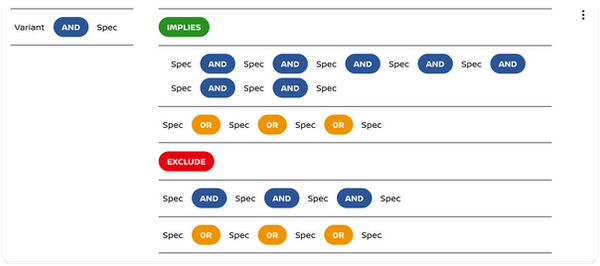
This can be considered an improvement over iteration 1, as it attempts to group implies/exclude as main and as a subgrou to the final approach.
During testing with users in European markets, there was a blocker as the constraints to be created were longer and more data-intensive. A study was conducted on the new types of data authoring in markets, and the following direction was adopted in Iteration 2

Revised the approach with new requirements and collaborated with multiple markets to reach a common understanding of the 2 types of constrains. This was simplified with easy-to-understand language and multi-select options, which streamlined the whole process and generated multiple constraints in a single workflow.
Generic Constrain


Complex Constrain


Learning
Collaboration
Between regions led to a design solution that met both needs and delivered meaningful results.
Agile & Iterative
Launches won trust in the early stages and later enhancements that provided continuous improvement.
Leadership
helped collaboration and decision-making to deliver impactful outcomes.